Test setup
Engine: the optimizer on this site, version of November 10, 2026, run in the browser. Machine: a laptop with an Intel Core i5-1135G7 and 8 GB of RAM, Windows, Chrome 157. Method: each configuration was calculated 15 times in a row; we report the median time, with the fastest and slowest run. Yield is the area of all the parts divided by the area of the sheets used.
The 15 parts
| Part | Width × height (mm) | Width × height (in) | Qty | Grain in run 2 |
|---|---|---|---|---|
| Side | 560 × 720 | 22 1/16 × 28 3/8 | 2 | — |
| Top | 764 × 560 | 30 1/16 × 22 1/16 | 1 | — |
| Bottom | 764 × 560 | 30 1/16 × 22 1/16 | 1 | — |
| Shelf | 762 × 540 | 30 × 21 1/4 | 2 | — |
| Divider | 540 × 684 | 21 1/4 × 26 15/16 | 1 | — |
| Door | 397 × 716 | 15 5/8 × 28 3/16 | 2 | Locked |
| Back | 764 × 684 | 30 1/16 × 26 15/16 | 1 | — |
| Plinth | 764 × 100 | 30 1/16 × 3 15/16 | 2 | — |
| Rail | 764 × 80 | 30 1/16 × 3 1/8 | 2 | — |
| Drawer front | 176 × 796 | 6 15/16 × 31 5/16 | 1 | Locked |
The same list as CSV (name, width, height, quantity), in millimeters:
Side,560,720,2
  Top,764,560,1
  Bottom,764,560,1
  Shelf,762,540,2
  Divider,540,684,1
  Door,397,716,2
  Back,764,684,1
  Plinth,764,100,2
  Rail,764,80,2
  Drawer front,176,796,1
And in inches, for the optimizer’s inches mode (fractions to 1/16 in):
Side,22 1/16,28 3/8,2
  Top,30 1/16,22 1/16,1
  Bottom,30 1/16,22 1/16,1
  Shelf,30,21 1/4,2
  Divider,21 1/4,26 15/16,1
  Door,15 5/8,28 3/16,2
  Back,30 1/16,26 15/16,1
  Plinth,30 1/16,3 15/16,2
  Rail,30 1/16,3 1/8,2
  Drawer front,6 15/16,31 5/16,1
Results
| Run | Sheet | Kerf | Trim margin | Grain | Sheets | Average yield | Yield per sheet | Time (median, min–max) |
|---|---|---|---|---|---|---|---|---|
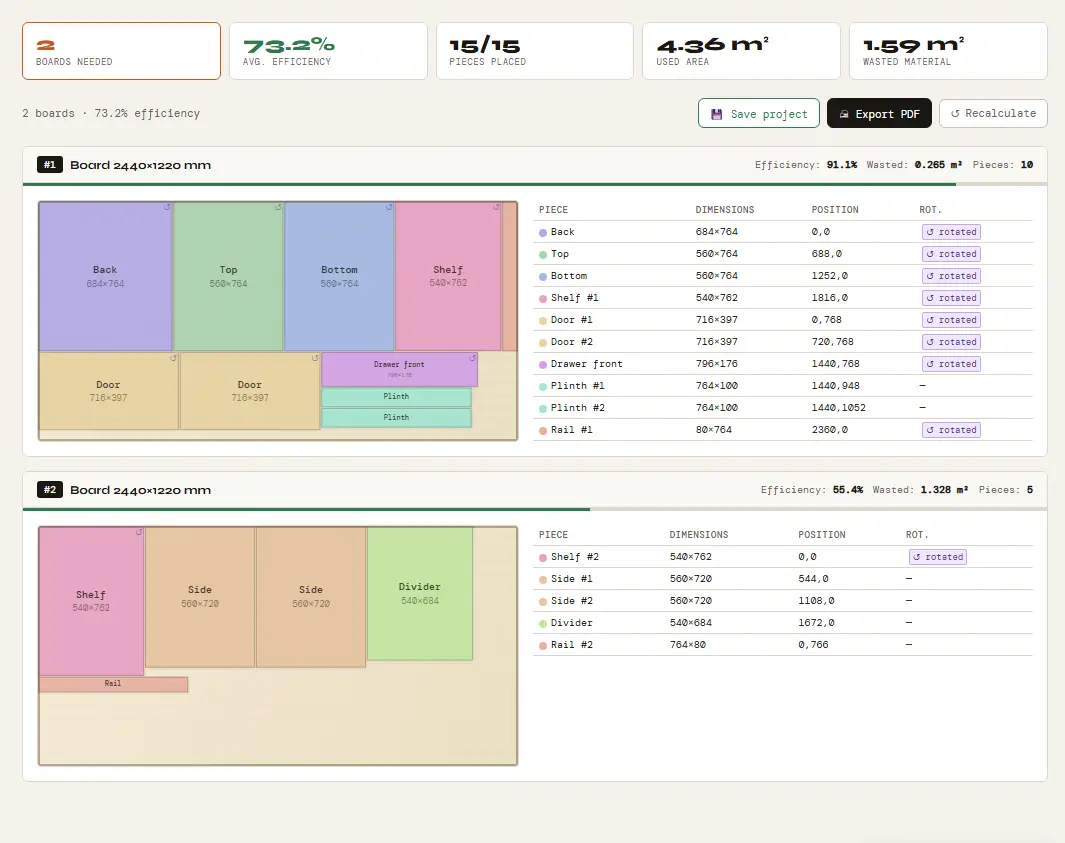
| 1 | 2440 × 1220 mm | 4 mm | 0 | Off | 2 | 73.2% | 91.1% · 55.4% | 5.8 ms (5.1–14.4) |
| 2 | 1220 × 2440 mm (grain along 2440) | 4 mm | 10 mm | Doors and drawer front locked | 2 | 73.2% | 89.1% · 57.4% | 4.3 ms (3.5–14.9) |
| 3 | 48 × 96 in | 1/8 in | 0 | Off | 2 | 73.3% | 91.2% · 55.5% | 5.3 ms (3.9–11.2) |
All 15 parts were placed in every run. In run 3 the parts are the inch values from the CSV above, which round each size to the nearest 1/16 in, so they are not identical to run 1. In the parts list, a grain-locked part’s height is the direction its grain runs: the doors run vertically and the drawer front horizontally.
Sheet orientation matters with grain
In our optimizer, a grain-locked part keeps the orientation you enter, with its height along the sheet’s height. So with grain on, enter the sheet with its grain direction as the height: run 2 uses 1220 × 2440 mm for a sheet whose grain runs along the 2440 mm length. Entered the other way round, as 2440 × 1220 mm, the grain would run across the sheet and the locked parts could not lie along it. Our MDF vs plywood test shows a cabinet going from 2 sheets to 3 for that reason alone. For a grain-locked plywood job in inches, see the plywood cut list example on 4×8 sheets.
How to reproduce it
1. Open the optimizer and enter the sheet, kerf and margin of the run. 2. Paste the CSV into Import CSV and press the import button. 3. For run 2, enter the sheet as 1220 × 2440 mm, switch on Board with grain/fiber and tick the grain box on the doors and the drawer front. 4. Press Calculate optimization and compare the sheets and yield. Times depend on your device.
What this benchmark does not cover
It shows our results only. We have not run this list in other tools, so this page makes no comparison. If you run it elsewhere, use the same sheet, kerf, margin and grain settings so the numbers mean the same thing. Features and prices are compared on a separate page: compare cut list optimizers.
Run the test yourself
Paste the CSV into the optimizer and calculate. No sign-up needed to start.
▶ Open the optimizerFAQ
What does yield mean in this test?
The area of all the parts divided by the area of the sheets used, including any trim margin. It does not count offcuts as used.
Why is run 2 entered as 1220 × 2440 mm?
Because grain-locked parts keep their height along the sheet’s height. Entering the sheet as 1220 × 2440 mm makes the grain run along its 2440 mm length, so the doors and drawer front can lie along it. With that orientation, run 2 also fits on 2 sheets, despite the 10 mm trim margin.
Can I run this list in another cutlist optimiser?
Yes. The CSV uses four columns, name, width, height and quantity, so you can paste or import it into most tools. Use the same sheet, kerf, margin and grain settings to compare.